Thursday, March 25, 2010

ESAF Part I: Testing the Business Model

I will be writing a small series to provide further insight into the Early Stage Analysis Framework (ESAF). I recently posted to the blog. This will be somewhat out of order, as I will try to follow up based on discussions that I have with others in the blogosphere.

Today I wanted to address the question of how to test the business model. In ESAF, I suggest that there are 3 key steps to understanding whether a business model is sound:
  1. Create a unit economic model of the business to understand the key revenue and cost drivers
  2. Conduct break-even analysis on the unit level to see if the company can generate margins on each unit. If this isn't the case, expand the model to take into account multiple units and see what scale is required for the company to reach break-even.
  3. Conduct Crystal Ball analysis to understand expected profit values based on a Monte Carlo simulation and de-risk the business model
I devised this approach after working for quite some time with both entrepreneurs and investors in early stage companies. I found that very often they spent a lot of time breaking down complex 3-5 year models and questioning key assumptions that the model makes. This is often a highly time consuming (and subjective!) process and often means very little since both sides stand firm behind their own assumptions. The challenge for me was to devise a way of testing business viability in an objective way without taking any position on what assumptions were 'reasonable'. This was key in getting buy-in from investors and entrepreneurs on the validity of my analysis. I outline my approach below.

First, creating a unit economic model is crucial because it strips the business down to its core revenue/cost drivers and eliminates the unnecessary complexity that most models have. This model is created by identifying an economic unit for the business (whether it is a cookie, a box of cookies, a delivery truck of cookies or the daily supply an average supermarket purchases) and allocating all revenues and costs (both variable and allocated overhead) to that unit.

Once we have this unit economic model, we simply ask the objective question of whether the business model is viable given the existing market size. If the unit has a positive margin in the model, immediately we know that the business model is validated. If the unit runs a loss, the model can be enhanced to account for multiple units to see if the company can break even as it scales up (and economies of scale lower overhead cost down across all economic 'units'). Once break-even volume is determined, this can then be compared to market size to judge whether or the business is viable. For example, if you found that it would take 9 billion customers to sign up for an annual subscription to your web service, you have objectively proven that the business is not viable since there are some 6 billion people in the entire world. When we conduct our break-even analysis , all we test is business viability. This does not take into account whether the business can actually achieve the market share necessary to break even (we examine this question later). It is an objective analysis that can be understood by everyone around the table.

If the business seems viable from a unit economic model perspective, the next thing to test is whether it can actually meet the ROI targets necessary to make the business worthwhile to the entrepreneur and investor. To do this, a Monte Carlo Simulation software such as Crystal Ball can be used. This software allows you to create a basic financial model and designate 'ranges' for inputs (ie: sales figures, resource costs, etc) instead of coming up with distinct best/worst/expected case scenarios. For example, if you think that salaries might be in the $40k-60k range with an average of $48k, it will allow you to input these ranges into the system. Once this is complete the software will iteratively simulate thousands of possible scenarios across all model inputs and generate two key outputs. The first output is a chart outlining results from the simulation with expected outcomes. Lets take this chart as an example:
This chart shows that across several thousand simulations performed on the input model , the business can indeed suffer a loss, although the expected value is a net income of $6K a year with an optimistic scenario of ~$12K. This data can be extremely useful when trying to compute ROI targets and value a company.

The second key output is a tornado chart that illustrates the key sensitivities of the business model. While running random simulations, the software isolates the most sensitive drivers of profitability and presents them in the form below:
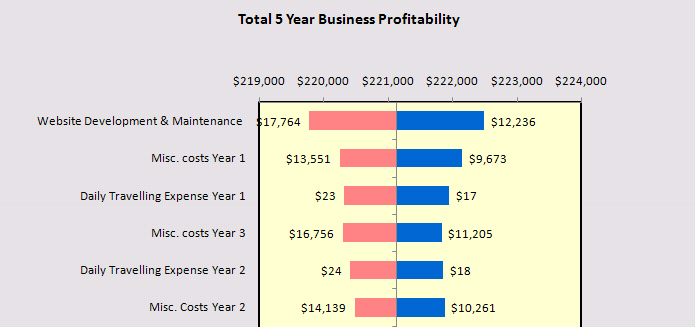
This tornado chart shows the most sensitive variable in the model is Website Development costs (which will in the best case be ~$12K and in the worst case ~$18K.) Using this insight, entrepreneurs and investors can understand the key risks in the business and take steps to mitigate the key drivers of risk.

My experience has shown me that 'objective' analysis is crucial in the initial stages of discussing business models with early stage companies, as it ensures buy-in from both entrepreneurs and investors. Otherwise, there is simply too much room for subjectivity when looking at assumptions one by one and debating whether they are reasonable.

Sunday, March 21, 2010

Early Stage Analysis Framework

This is a little project I developed over a weekend. It is the culmination of 4 years of experience in working with bootstrapped and VC/PE backed early stage companies. I welcome any and all feedback!

Early Stage Analysis Framework v2

Friday, November 20, 2009

Why Are Entrepreneurs That Way?

How does an entrepreneur think and what is that unscratchable itch that drives them? From time to time I ask myself these very questions and when I need a little perspective, I turn to the wisdom of Thoreau. These two paragraphs come from the final chapter of his book Walden:

I left the woods for as good a reason as I went there. Perhaps it seemed to me that I had several more lives to live, and could not spare any more time for that one. It is remarkable how easily and insensibly we fall into a particular route, and make a beaten track for ourselves. I had not lived there a week before my feet wore a path from my door to the pond-side; and though it is five or six years since I trod it, it is still quite distinct. It is true, I fear, that others may have fallen into it, and so helped to keep it open. The surface of the earth is soft and impressible by the feet of men; and so with the paths which the mind travels. How worn and dusty, then, must be the highways of the world, how deep the ruts of tradition and conformity! I did not wish to take a cabin passage, but rather to go before the mast and on the deck of the world, for there I could best see the moonlight amid the mountains. I do not wish to go below now.

I learned this, at least, by my experiment: that if one advances confidently in the direction of his dreams, and endeavors to live the life which he has imagined, he will meet with a success unexpected in common hours. He will put some things behind, will pass an invisible boundary; new, universal, and more liberal laws will begin to establish themselves around and within him; or the old laws be expanded, and interpreted in his favor in a more liberal sense, and he will live with the license of a higher order of beings. In proportion as he simplifies his life, the laws of the universe will appear less complex, and solitude will not be solitude, nor poverty poverty, nor weakness weakness. If you have built castles in the air, your work need not be lost; that is where they should be. Now put the foundations under them.


Tuesday, November 10, 2009

Why Start a Company When You Could...

There's a lot of opportunity out there and I've been hearing some interesting insights from several entrepreneurs recently who've been very much against the idea of someone starting their own company. The argument is that there is so much risk in a pre-revenue venture (after all, creating something from nothing is the hardest part). So then, they ask, why wouldn't you:
  1. Join a revenue generating start-up? A huge part of the risk has been taken away and the question isn't as much 'whether this will ever work ' but how we can now tweak the business to grow revenues. You won't get anywhere near the same amount of stock but a lot of people have made good money this way (and built their networks through venture backed companies).
  2. Buy an existing business that's stagnant. Again, the hard part has been done. There are businesses out there that are profitable but stagnant making between $100k-5mm a year. So rather than trying to start a business why not raise some private money and flip the company around?
The moral is that there are a lot of undervalued assets out there that can use an individual's talents just as well as any bright new business idea.

Tuesday, November 3, 2009

Viral Marketing & Design on FaceBook

A very interesting area I'm working on right now is Viral Marketing and Viral Design. As progress on Triip continues to move forward (predicting Launch in early December!) the team has been asking a lot of questions on how to launch our FaceBook app & how to add features that will optimize virality.

The presentation below is a stripped down (sorry!) version of a deck I created to show our engineering team how Marketing and Viral Design are essentially the same thing on a social media platform. The objective is to logically break down the question of 'how to do we get 100000 users?' into simpler parts and see what actionable steps we can take to reach success.


FB App Virality Drivers

Wednesday, October 14, 2009

A framework for success

What is success? If you can't set the vision, you'll never reach it. that's why i came up with three criteria based against which the success of all current/future passion projects that I participate in will be based:
  1. it should challenge an existing paradigm and make people think
  2. it should empower people to do something they otherwise wouldn't be able to do
  3. it should engage and inspire people to act


Tuesday, October 13, 2009

Release Early & Release Often

"Release Early, Release Often" is a principle that is now adopted by some of the most successful companies in internet. I've known of it, incorporated it in the develop strategy of KnolSoft's internet product but I never actually knew how amazing it was until I started my little mashup experiment Googview.

GoogView Started off with a simple question: if people like Google search yet they keep going to Bing for the daily image, what would happen if we combined the two? The first iteration was simply the current Google Search with a background that I selected from Wikipedia picture of the day. People who I gave the simple pitch to loved it but other people didn't quite get it. After this I kept tweaking the site based on user suggestions daily. The rapid changes kept even the people who weren't that into it at first interested and I was able to keep the communication going. The result was a significantly better website design, users participation and a lot of fun. So, what were the lesson I got out of this?
  1. Iterative development is an extremely powerful tool and it must be incorporated into your product strategy.
  2. You have to iterate fast and work hard to keep dialogue going and maintain user interest.
  3. If you don't have the infrastructure in place to go through this cycle rapidly, you're not ready to launch. If it means more manpower, get it.